

When Taylor Swift released “Opalite,” she didn’t just drop another song. She started a conversation about crystals. One song about a shimmering stone sent a wave of curiosity through millions of people who might never have looked twice at a crystal before. Within days, I began receiving messages from across the country from collectors, new followers, and travelers planning their first trip to Sedona.
“Is Opalite real?” “What does it mean?” “Do you sell it in your shop?”
I love moments like this because they open space for learning, for feeling, and for remembering what’s real. Taylor has always had a way with words and with “Opalite,” she’s invited people to explore a kind of light that goes deeper than surface shimmer. But before we can appreciate its beauty, we have to understand what it truly is and why this conversation matters.

What Opalite Actually Is
Despite its ethereal glow, Opalite isn’t a natural gemstone. It’s a synthetic glass created to mimic the look of true opal. Its milky, luminous appearance comes from the way light bends through layers of glass rather than from natural mineral composition.
That doesn’t make it less beautiful. It simply tells a different story. Opalite is a human creation. It’s art, chemistry, and design; not geology. It’s the reflection of what we love about opal, reimagined through our own hands.
The problem is that its name makes it sound like something natural, when in truth, it’s man-made. Understanding that difference is the first step toward an honest relationship with what we bring into our energy field.

Understanding Natural, Lab-Grown, and Synthetic Stones
The language around crystals can be confusing. Here’s how I explain it during live sales and in my Sedona shop when people are just starting their journey.
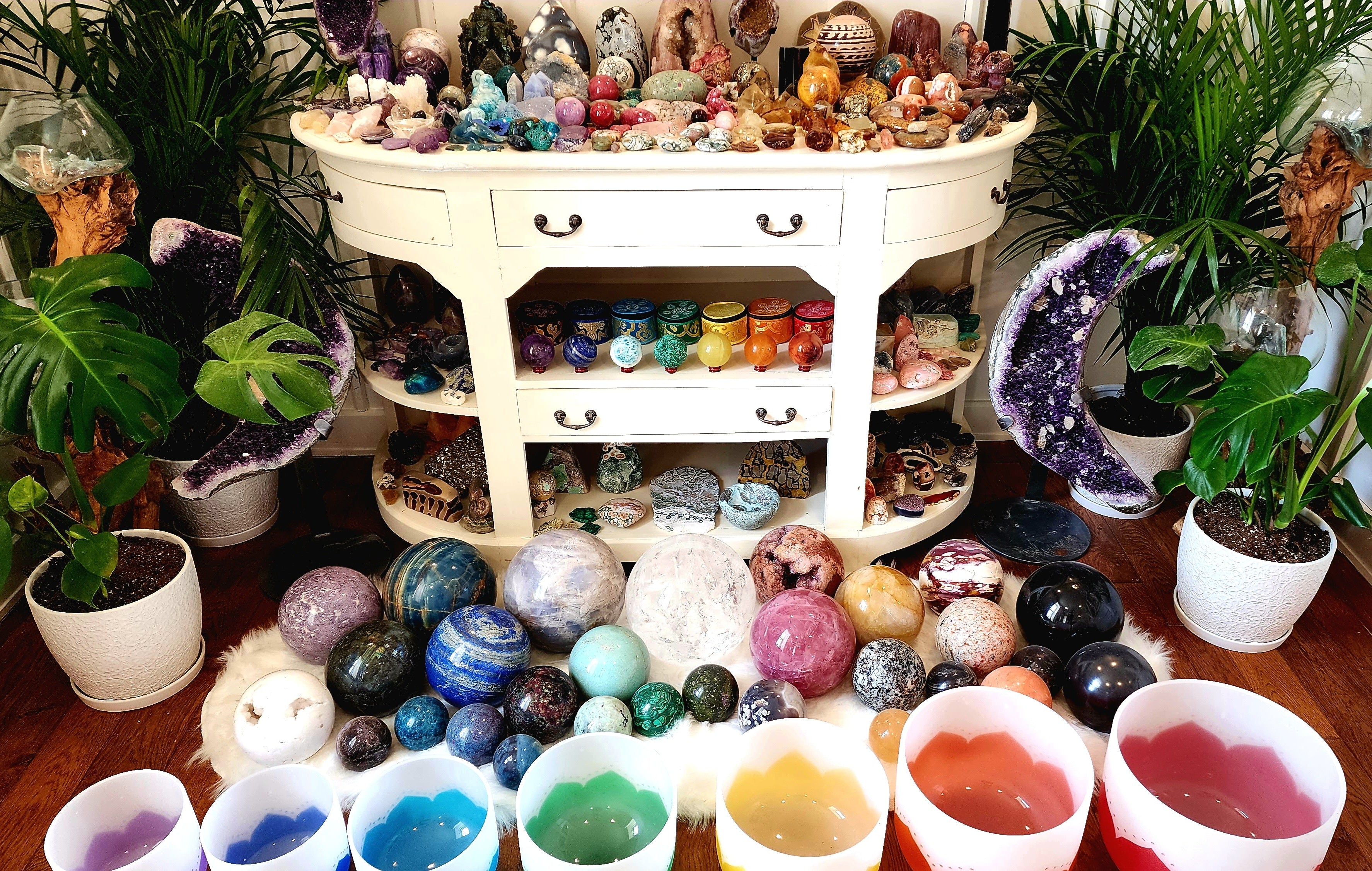
Natural stones form within the Earth through elemental forces: heat, water, pressure, and time. Over thousands or even millions of years, elements form minerals that form into precise geometric patterns called a crystal lattice. This atomic symmetry gives them measurable vibration and energetic resonance. They are literally the Earth crystallized into light.
Lab-grown stones are real crystals created by replicating the natural process in a controlled environment. They share the same chemistry and structure as their natural counterparts but are accelerated in time. You might think of them as genuine but guided, identical in composition yet without the geological story that took eons to write.
Synthetic stones are imitations that capture a look but not a structure. They’re usually made from glass or fused minerals that recreate color and transparency without the lattice that gives a natural crystal its vibration. Opalite belongs in this category.
Knowing these distinctions doesn’t just protect you from misinformation. It deepens your appreciation for how extraordinary natural crystals really are. When you realize what goes into their formation, you begin to see them not as objects but as expressions of the Earth’s memory.
The Energy Science Behind It
Every natural crystal holds a consistent energetic vibration. That vibration, the result of its internal order, is why quartz can regulate time inside watches and computers. This phenomenon is called piezoelectricity, the ability of certain crystals to generate an electrical charge when mechanical pressure is applied. When a crystal is squeezed, it releases an electric potential; when electricity passes through it, the crystal vibrates.
It’s the same mechanism that allows ultrasound machines to produce sound waves, microphones to capture voice, and quartz clocks to keep perfect time. Crystals transform pressure into energy and energy into vibration. That vibration is what we feel energetically when we hold a natural stone. Each crystal’s lattice structure vibrates at its own frequency, its resonance, and when it interacts with our body’s biofield, the two frequencies begin to harmonize. This is why crystals can bring calm to anxiety, focus to chaos, and coherence to scattered energy. They remind the body of what balance feels like.
Synthetic glass doesn’t have this structure. Its atoms are arranged randomly, so it doesn’t generate or conduct energy in a consistent pattern. It can reflect light beautifully but it doesn’t resonate. There is no internal pulse or coherent frequency to entrain with your energy field. That doesn’t mean it lacks meaning. If you choose to work with Opalite intentionally as a symbol of truth or transformation, it can still mirror your focus and amplify your intention. But its energy comes from you, not from the Earth’s electrical matrix.
Natural crystals are both science and spirit. They are ancient conductors of energy, connecting the physical and unseen realms through vibration. When you hold one, you’re holding energy that has been pulsing within the planet for millions of years.
Why Taylor Swift Made Opalite Trend
Taylor has always been a storyteller who transforms emotion into imagery. In “Opalite,” she used the stone as a metaphor for the light that remains after change, the translucent beauty that follows truth. It’s vulnerablity, reflection, and strength in the same breath.
Since the album’s release, Opalite has become more than a song. It’s a symbol of transparency and renewal. Social feeds filled with bracelets, pendants, and points glimmering under sunlight. People who had never touched a crystal before wanted to understand why they felt drawn to it.
Here in Sedona, I’ve seen that same curiosity reflected in our visitors. Some walk in wearing Opalite jewelry and leave with Moonstone or natural Opal once they learn the difference. Others keep their Opalite but hold it with new respect as a reminder that beauty comes in many forms, but authenticity carries its own vibration.
Natural Crystals That Hold the “Opalite” Light
If you’re drawn to Opalite’s soft glow, you’re really resonating with a frequency of clarity, emotional healing, and communication. Here are natural crystals that express that same energy, each one created through the true alchemy of the Earth.
Opal: A stone of inspiration, joy and creativity. It amplifies your intentions, deepens intuition, and manifestations.
Moonstone: Known as the stone of new beginnings. It guides you through transformation with grace and trust, enhancing intuition and grounded action.
Blue Chalcedony: Gentle and harmonious. It calms anxiety and brings peace to conversations, helping you express truth with softness.
Selenite: Pure light crystallized. It clears stagnant energy, uplifts vibration, and reconnects you to feminine energy.
Danburite: A radiant bridge between heart and spirit. It carries angelic energy, bringing forgiveness, serenity, and soul-level clarity.
When you hold these stones, you can feel the difference immediately. Each one carries an echo of creation, reminding you that real transformation takes time.
From Sedona: Where Earth Energy Teaches Through the Land
Sedona is one of the most magical places on Earth. You can feel it the moment you arrive. That’s why I built Enchanting Earth here. The energy of this place amplifies everything that’s authentic.
Every crystal in our shop is ethically sourced, hand-selected, and vortex-charged here in Sedona’s energy field. When I place stones in the Earth before bringing them to the shop, I feel them awaken. People often tell me they can feel the difference of our stones and our shop.
We do not carry synthetic stones like Opalite or other glass-based materials. Our focus is on earth-born and energetically active crystals that hold Earth energy. However, you will sometimes see lab-created gems such as Moissanite in our fine jewelry collection. Moissanite is rarer than Diamonds, so when we offer it, it’s a consciously chosen lab-grown version made to exacting standards. It has a natural crystal lattice and vibrational resonance similar to quartz, making it an attractive high-frequency gem for those who want sustainable brilliance without the high price of a natural or lab-created Diamond.
Transparency is part of our promise. Every time you join one of our live shows or shop online, any gem enhancement or lab-created gemstone will always be disclosed in the listing and description. I believe energy work begins with honesty, and that knowing what you hold in your hands is part of the magic.
A Reflection on the Song opalite and Its Meaning
Taylor’s song has created a rare and beautiful opportunity. It’s brought the world’s attention to the world of crystals. It’s also reminded us that we live in a time where imitation and authenticity often blur.
The answer isn’t to dismiss what’s synthetic or glorify what’s natural. It’s to understand them both. When you learn how something is made, you engage with it consciously. You begin to choose based on energy, not trend, and learn to trust your intuiton. Awareness is empowerment. It’s the moment your relationship with crystals shifts from collecting pretty things to working with tools of creation.
To me, “Opalite” isn’t just a song. It’s a metaphor for clarity, for seeing yourself honestly in the reflection of your own light. Opalite may be glass, but what it mirrors is very real: the desire to be transparent, the courage to let the world see you, flaws and all. That’s what crystal work teaches too. Every natural stone is a record of transformation: heat, pressure, and time turned into beauty. Opalite reminds us that surface beauty will always invite us to look deeper. What gives something real power isn’t how it looks, but what it’s made of.
If your journey brings you to Arizona, come experience the power and beauty of crystals at our shop:
📍 Enchanting Earth
2675 W State Rte 89A Suite A
Sedona, AZ 86336
You can explore our full collection of natural crystals, vortex-charged jewelry, and ethically sourced stones at enchanting-earth.com. And if you’d like to learn more, visit jamieinglett.com to claim my free Crystal Codes course and receive updates on Sedona workshops, meditations, and future classes.
With love and light,
Jamie Inglett

Jamie Inglett
Jamie Inglett is an intuitive healer, author, founder and CEO of Enchanting Earth; a luxury gemstone jewelry and crystal shop with a storefront in Sedona, Arizona. Known for her deep knowledge of crystals and energy healing, Jamie has studied metaphysics since her awakening at a Quartz mine in 2012. Her Sedona storefront is a must-visit destination for crystal lovers, offering luxury gemstone jewelry, rare & ethically sourced crystals, and powerful healing tools; all charged in the energy of Sedona’s sacred red rock vortex. She retired from her successful banking career to pursue her mission of spreading empowerment, love, and healing through crystals. Jamie loves to teach crystal healing live on her social media channels. Further your crystal knowledge and join the enchanting community on Instagram @enchantingearthco


Leave a comment