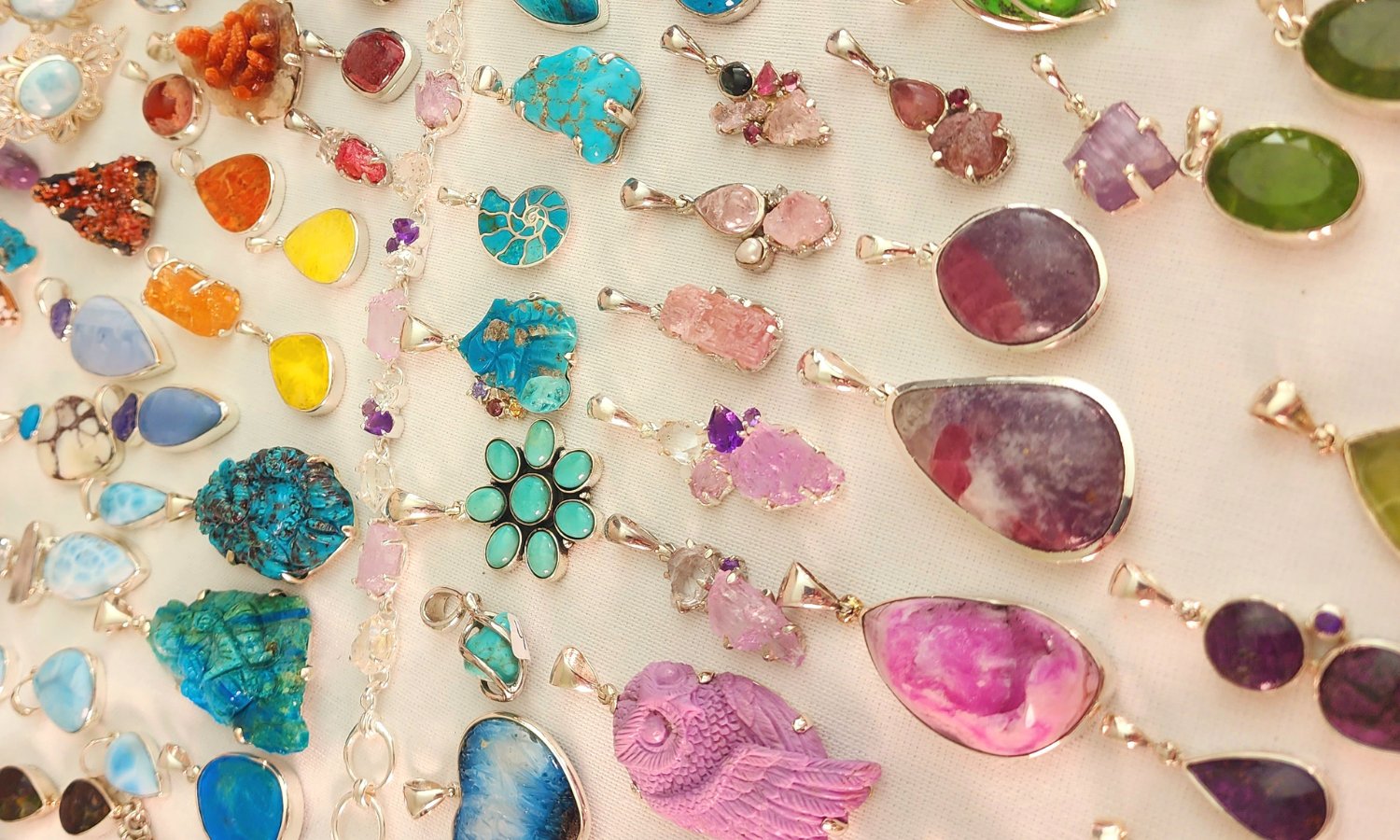



Absolutely enchanting Rutilated Zoisite Pendant in rhodium plated, .925 Sterling Silver.
This beautiful, high quality, Rutilated Zoisite was hand picked with intention just for you by Rick and Jamie and set in our best selling, rhodium plated, .925 Sterling Silver adjustable setting. This will be a beautiful heirloom in your collection to enjoy for generations!
~Rutilated Green Zoisite Metaphysical Properties~
♡ Chakra: Heart, Third Eye
♡ Element: Earth, Spirit/Ether
♡ Numerology: 5
♡ Zodiac Sign: Gemini, Sagittarius, Pisces
♡ Brings emotional renewal, insight, and inner reconnection
♡ Enhances intuition, emotional processing, and mental clarity
♡ Helps release emotional fragmentation and reconnect scattered energy
♡ Promotes self trust, integration, and visionary thinking grounded in action
♡ Supports the nervous system and energetic recovery after emotional exhaustion
Rutilated Green Zoisite is a complex metamorphic mineral aggregate composed primarily of zoisite with naturally included rutile needles, most commonly golden, bronze, black, or copper-toned titanium dioxide crystals embedded throughout the host stone. Zoisite itself is a calcium aluminum hydroxy sorosilicate belonging to the orthorhombic crystal system, forming in regional metamorphic environments where intense pressure and hydrothermal alteration reshape preexisting rock. Green Zoisite develops its coloration through chromium and vanadium content within the crystal lattice, creating shades that range from mossy olive and forest green to deep mineral-rich jade tones. The rutile inclusions form separately as elongated prismatic crystals that become trapped during growth, creating directional internal structures that refract and scatter light in linear flashes across polished surfaces.
The physical appearance of Rutilated Green Zoisite varies dramatically depending on rutile density and orientation. Some specimens display sparse silk-like inclusions suspended through translucent green material, while others contain dense metallic veining that creates dramatic internal texture and movement. The luster ranges from vitreous to slightly silky where rutile concentrations become heavy. Zoisite possesses good toughness but imperfect cleavage, with a Mohs hardness typically between 6 and 7, allowing the material to be carved, polished, and stabilized into jewelry and collector specimens. When polished into cabochons or freeforms, the rutile can create subtle chatoyant movement caused by directional reflection from aligned titanium dioxide fibers within the host matrix.
Green Zoisite belongs to the same mineral family as Tanzanite, which is the blue to violet gem variety of zoisite colored by vanadium and altered through geological heating. Both materials share identical core chemistry and orthorhombic crystal structure, though their coloration and optical behavior differ due to trace elements and thermal conditions during formation. In some deposits, transitional material occurs where green zoisite merges into blue-violet zones associated with Tanzanite-bearing environments. This relationship is especially significant in East African metamorphic belts where tectonic activity, heat, and mineral-rich fluids produced multiple color expressions of zoisite within the same geological systems.
The name zoisite was established in 1805 by mineralogist Abraham Gottlob Werner in honor of Slovenian naturalist Sigmund Zois von Edelstein, who supported early mineralogical research and specimen collection. Tanzanite itself was only commercially recognized in the twentieth century after discoveries in Tanzania near Mount Kilimanjaro, though green zoisite material had already been documented within metamorphic terrains worldwide. Rutilated Green Zoisite remains considerably rarer in the lapidary market due to the specific geological conditions required for both rutile crystallization and zoisite stabilization to occur simultaneously in visually desirable patterns.
Documented sources of Green Zoisite include Tanzania, Kenya, Austria, Norway, Pakistan, and parts of India, though rutile-rich material suitable for cutting is most strongly associated with East African deposits. In gemological and collector communities, interest in Rutilated Green Zoisite has increased because of its visible structural complexity and its connection to the same geological lineage as Tanzanite. Unlike Tanzanite, however, Green Zoisite has not historically carried widespread commercial branding or ancient cultural mythology, and most metaphysical associations surrounding the stone are modern experiential interpretations rather than historically documented traditions.
Rutilated Green Zoisite carries an emotional atmosphere that feels layered and internally active. Many people experience it as a stone that brings hidden emotional material to the surface in strands rather than waves. The rutile inclusions create a sensation of movement that can feel directional and specific, almost like tracing pathways through old emotional memory. Green Zoisite itself contributes a restorative quality associated with growth, reconnection, and renewed emotional circulation. Together, the combination often resonates with people moving through burnout, grief, emotional stagnation, or periods where identity has fragmented under prolonged stress.
Rutilated Green Zoisite is frequently associated with reconnecting intuitive perception to grounded embodiment. Its relationship to Tanzanite creates an interesting energetic bridge between the heart, mind, and higher intuitive centers. Where Tanzanite is often experienced as expansive and visionary, Green Zoisite tends to translate intuitive information into something more physically integrated and emotionally digestible. During meditation, many people describe sensing information arriving in streams, symbols, or threads that gradually weave together into understanding over time. The rutile inclusions often feel like conductive channels that direct awareness inward with unusual focus.
Energetically, the orthorhombic structure of zoisite creates movement that many experience as linear, organized, and distributed through multiple energetic centers simultaneously. The embedded rutile changes this flow dramatically by introducing concentrated directional currents that feel like fine metallic pathways moving through the body. Rather than dispersing outward, the energy often feels threaded through the nervous system and spinal column in narrow bands of sensation. This combination of structured host crystal and penetrating inclusions gives Rutilated Green Zoisite an unusually interconnected energetic rhythm that many people experience most strongly during deep meditation, emotional processing work, or periods of personal reintegration.
Each piece of jewelry or crystal is energetically charged by Jamie, Spiritual Teacher and founder of Enchanting Earth, in Sedona's sacred vortex energy. Infused with love and intention, these pieces ship from our shop in Sedona, Arizona.
You will receive the Pendant of your selection.
Please note: As it is a natural stone, no two will be alike. Natural stones have varying shades, line patterns and inclusions. Natural stones may have chips, cracks or other imperfections. We cannot guarantee perfect points or stones.
Disclaimer: Metaphysical properties are provided for informational purposes only. Consult a licensed healthcare professional for medical advice or concerns. All statements made have not been evaluated by the Food & Drug Administration. Our products are not intended to diagnose, cure, or prevent any disease. If a condition persists, please contact your physician or health care provider. The information provided by this website or Enchanting Earth is not a substitute for a consultation with a health care provider, and should not be construed as individual medical advice.
Infused with love and intention, these pieces ship from our shop in Sedona, Arizona. Please allow 1-3 business days for order processing (excluding holidays and weekends). During the holiday season, please allow extra time for shipping and delivery.
For additional details, please review our shipping policy.
Our signature custom cuff rings adjust to fit ring sizes 4-11. Midi rings adjust to fit ring sizes 1-9. If you have specific sizing or additional questions, please reach out to us on Instagram or email hello@enchanting-earth.com
We are passionate about our best selling crystal bracelets and want you to be in love with the stone and fit! Understanding your bead size selection as well as wrist size will help you in selecting a bracelet you will love every time! Check out our bracelet size guide!

Ready to transform your life with the power of healing crystals? Join our crystal community on Instagram! I share educational content on crystals, manifestation and spirituality. We go live to showcase our beautiful jewelry and crystal offerings you can purchase on live sales!! Our community has inspired so much love, healing, friendships and growth all over the world! We would be honored to have you!